
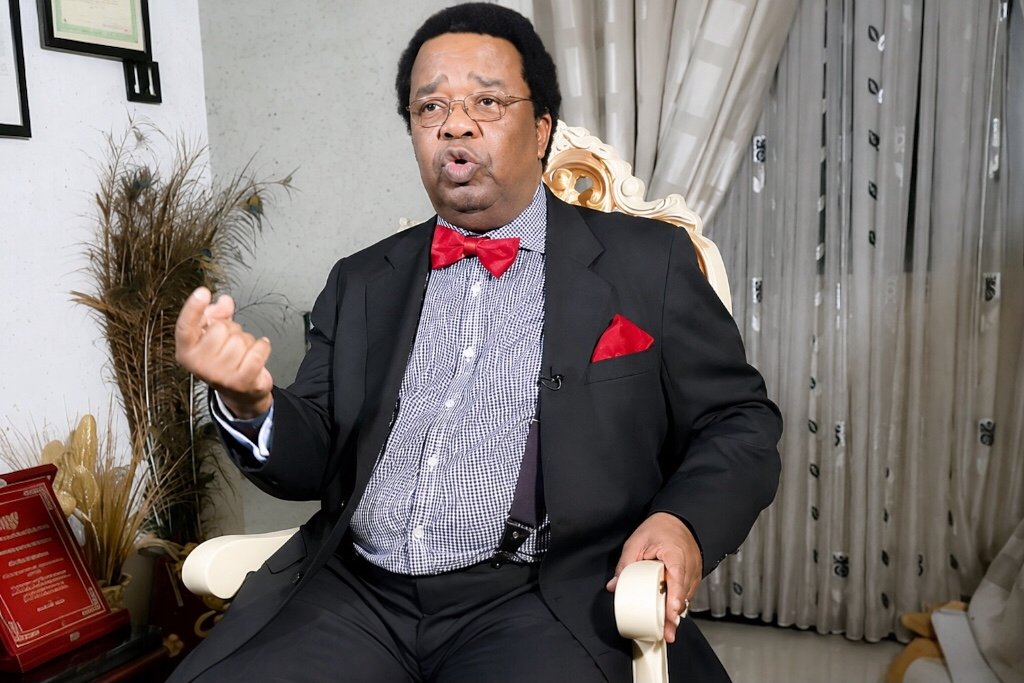
Professor Akinwande Bolaji Akinyemi, the son of a priest and politician, is an academic colossus whose impact on various aspects of Nigerian life cannot be captured in a single tribute. He is a scholar, policymaker, adviser, public intellectual, and a man with extensive academic engagements and networks.
He began lecturing at the premier University of Ibadan after returning from the USA with the enviable record of having obtained a PhD at less than thirty years of age from a towering American university. This capped his initial academic training at the University of Oxford in the UK.
After some years, and following his elevation to the rank of Senior Lecturer at Ibadan, he moved to Lagos to inject new life into the Nigerian Institute of International Affairs (NIIA), which was then enmeshed in succession politics, having had three or more Director-Generals in quick succession. By popular acclamation, he performed exceptionally as DG of the NIIA, which he led for the record time of nine years. His tenure attracted both commendations and threats of removal, but the latter never materialised.
He has also served as Minister and has continued to undertake administrative assignments for the Nigerian State. It is therefore no surprise that the public space is usually filled with congratulatory messages during the season of Professor Bolaji Akinyemi’s birthday — a Professor of Political Science and International Relations, trailblazer, and public analyst who has dominated the ideas space for more than five decades
He shows no signs of slowing down, apparently because there are still many issues to discuss about Nigeria, especially in its relations with the rest of the world. He is a delight to watch and listen to when issues of international relations are up for mention and analysis. Truth be told, Professor Akinyemi is a pathfinder whose impact goes beyond the books he has written. Some professors, including this author, drew strong motivation and interest in International Relations from his impressive showings — hallmarked by calmness, confidence, and deep historical exposition — on public platforms in the 1970s and 1980s.
Arguably, he remains the most successful Director-General of the NIIA, judging by the public image of the Institute under him; his frequent policy interventions that almost got his fingers burnt; the level of collaborations with similar agencies across the world; the outcomes of conferences; and the record of publications under his headship. As DG, he was courageous in seizing the space to test his textbook theories of International Relations, most notably Realist Theory.
A perusal of his writings also reveals a living idealist who, out of frustration with apartheid South Africa, once called for the adoption of “black bombs” to deal with that obnoxious regime. His idealism also showed in his belief in the concept of Prior Consultations, and in his call for Nigeria to carry more burden for the African continent, notwithstanding mounting domestic problems. He is, however, known more for his relentless call to resist Western dictation, positing that even in a world decidedly tilted in favour of the West, Nigeria can still provide leadership for countries of the South by increasing its presence and visibility. Concepts such as the Concert of Medium Powers, Technical Aid Corps, and the African Petroleum Producers Association were bold initiatives enunciated by him to raise Nigeria’s voice in world affairs, in line with his realist orientation.
As Minister, he tried to actualise these pet projects. Recent world events have proven that he was, in a sense, a prophet — boldly canvassing for their adoption. The pursuit of these initiatives made him popular in some quarters, but also created problems for him in cabinet. His exit from the Babangida government remains a mystery to many, perhaps including Professor Akinyemi himself. He appeared to be doing well at his post. In a 2012 keynote in Ibadan at our Society’s conference, he disclosed that the only friend he had in cabinet was General Ibrahim Babangida, then Head of State. Why, then, did the tables turn? Extra-foreign policy matters were raked up and deployed against him. His handling of the issue of the State of Israel appeared to be the last straw. The thrust of his submissions was perceived differently by various actors. Those opposed to his position subsequently got him out of office. He was accused of being pro-Israel because of his life trajectory, while Israel itself was uneasy with him on some issues. One can, therefore, say that he was one of the few misunderstood Foreign Affairs Ministers in Nigeria who suffered a great dose of misrepresentation.
To some, he was not radical enough; at best a reformist, or what they called ultra-liberal. Others thought he was a Western apologist. There was clearly a mis-categorisation of his person and the ideas he pursued. My observation is that he tried his best to project Nigeria, but his steps were often misread on primordial and ideological grounds. As Minister, Prof. Akinyemi was a victim of circumstance — of an environment of suspicion where even academic colleagues were uncomfortable with his postulations. He was alleged to be implementing a certain agenda even by the Superpowers. He also incurred the wrath of China when, as DG of the NIIA, he demanded that the communiqué of a meeting with the Chinese team be drafted jointly. No major power fancies a jointly produced communiqué with Africa, preferring the unilateral for the advantage it confers.
Notwithstanding, some theoretical issues he introduced remain central to Nigeria’s foreign policy. For instance, his attempt to seek more input from Nigerians in foreign policy, which he spearheaded at NIPSS, Kuru, in 1986, is still being agitated for today as a desideratum for rejuvenating Nigeria’s contemporary foreign policy. One also recalls that the concept of BRICS, now topical globally, bears substantial similarity to ideas he promoted as Foreign Affairs Minister.
After the NIIA, Prof. Akinyemi returned to the University of Lagos for teaching before pulling out to serve as Minister. He later entered politics, following in his father’s footsteps and contested for the presidency of Nigeria. Somewhere along the line, he stepped down for MKO Abiola, the eventual winner of the June 12, 1993 presidential election. The annulment of that election and the emergence of Sani Abacha as a maximum ruler with zero tolerance for opposition pushed Prof. Akinyemi into nomadism, moving from one Western capital to another to canvass support to end military rule and to avoid arrest. He was part of NADECO, which fought for the validation of the June 12 mandate. He returned to the country during the Abdulsalami Abubakar regime that paved the way for democracy in 1999.
As a witness to history, he served on President Yar’Adua’s Electoral Reform Committee and as Deputy Chairman of President Jonathan’s National Conference, among others. On each occasion, he tried to blend theory with praxis, with mixed results — impressing some and offending others — but no one could dismiss his brilliance.
Retirement has not stopped him from being a public intellectual. As usual, Prof. Akinyemi does not shy away from intervening on issues of public interest. His views were sought on Nigeria after the country was designated a “Country of Particular Concern” by the USA in 2025. He spoke candidly — an issue on which I had intended to weigh in, but later pulled back.
He supported the position that people of a particular faith were being persecuted in Nigeria. That stance proved controversial, as both the government and a section of the public did not consider it a welcome commentary. True to his realist outlook, however, he saw no reason to oppose American involvement in helping to tame the hydra-headed insecurity in Nigeria. His tolerance for possible US engagement on Nigerian soil drew a wave of reactions.
One thing is certain: Prof. Akinyemi’s trailblazing spirit ensures that he will always speak his mind, whether popular or not. His memory remains very sharp, and he has courted academic controversy since early in his career.
At the level of the NSIA, he witnessed its formation in 1971. Ever since, he has remained a consistent senior member of our Society. He kick-started the flagship programme on a sister association christened the NPSA Platform in 2021, where he spoke on Federalism and Nigeria’s Foreign Policy. He was among the first set of Political Scientists awarded the prestigious Fellowship of the NPSA in 2019, in recognition of his contributions to Political Science in Nigeria.
Worried about the quality of decisions coming out of Balewa House, and the low level of interest in international relations among Nigerians, he established the Academy of International Affairs a few years ago. While the vision is not yet fully realised, Prof. Akinyemi exudes confidence that it will be. That optimism may have encouraged his return to the NIIA, not as DG this time, but as Chair of its Board. He is back on familiar terrain.
Barely four months to the end of my tenure as President of the NPSA, I ran into the warm embrace of Prof. Akinyemi at the NIIA, Lagos. The first thing he said was, “Mr. President, come and sit beside me here,” apparently against protocol already established for the 50th Anniversary of the death of General Murtala Muhammed. I politely declined, feeling the seat was meant for Prof. Eghosa Osaghae, the current DG of the NIIA. Later, I got closer to him, and that contact allowed him to share thoughts on how to escape the grim financial circumstances we faced in the NPSA. The take-home is that both the NSIA and the NPSA are important to him — particularly their sustainability and impact. Both bodies have recognised him.
Let me confess that I have been invited to his Academy of International Affairs (AIA) and given the Academy Fellowship. However, I am not an active participant — a situation I suspect he is not happy about.
The Society wishes him good health and long life as he continues to show the way and help us find the compass to navigate our country away from its largely artificial afflictions. He is marching into his 85th birthday in January 2027.
On behalf of the interim executives of the NSIA, I congratulate the pathfinder, courageous scholar, notable policy advocate, and public intellectual on the naming of the Annual Distinguished Personality Lecture of the NSIA after him, in recognition of his role in the establishment of our Society. At its formation in 1971, he was called names and presented as the chief divider. He was not deterred. Together with like-minded people, he forged ahead to establish the Society. Although the NSIA has faced challenges in recent years, it is gratifying that the interim committee put in place about two weeks ago is working to revive the Society on the foundation laid by Prof. Akinyemi and his team.
One can conclude that Prof. Akinyemi deserves the honour being bestowed on him. He also played a significant role when the Nigerian Political Science Association (NPSA) was formed two years later.
Hassan A. Saliu
Interim President, the NSIA
July 22, 2026